Wegen Hegel: Filmscreening mit anschließendem Gespräch mit dem Regisseur und Produzenten des Films
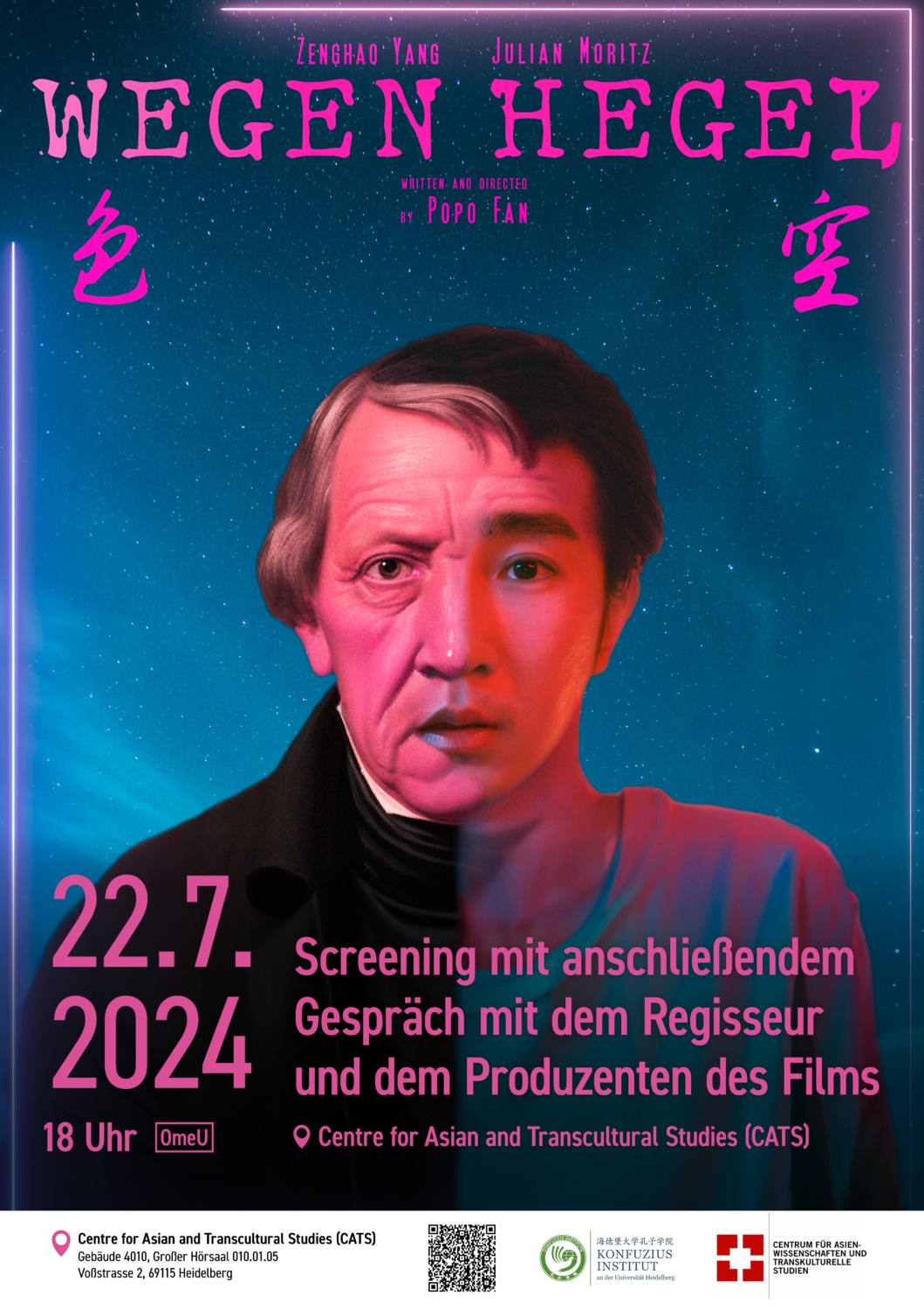
Klicken zum Vergrößern

Because of Hegel

2022

Short feature film

supported by production funding from MFG Baden-Württemberg

Screening and film talk with director Popo Fan and producer Daniel Tenné.

Moderation: Frederike Schneider-Vielsäcker

In cooperation with the Queer Colloquium of the University of Heidelberg.


“What is reasonable is real; and what is real is reasonable,” says the German philosopher Georg Wilhelm Friedrich Hegel. But when the pandemic hits Germany, everything changes. Chinese student PING has just started his philosophy degree and faces many obstacles: Hostility, loneliness, lockdown. Via a dating app, he receives hot photos from MAX, who suggests a “social distance hook-up”. Ping is thrilled and throws himself into the adventure. He is offered a mysterious drug and is about to have sex when a book suddenly catches his eye, a book by Hegel. It draws him into a drug-induced reflection on free will and reality, which destroys the mood of the moment. After an argument, he flees and loses himself in the drug trip. The next morning he makes another unexpected discovery – and it’s all because of Hegel.


Director: Popo Fan

Director: Popo Fan - © Nadja Wehling

Director: Popo Fan – © Nadja Wehling

Cinematography: Till Beckert

Editing: Sam Handel

Actors: Julian Moritz, Zenghao Yang

Production company: 70 Steps (Stuttgart)

Producers: Junus Baker & Daniel Tenné


International Graduate Student Conference 2024 – Forms of Embodiment: Transcultural Perspectives

The corporeality of a human being—the body—and the human mind have for long been taken to be distinct. Both are, and have since been, core themes of philosophical and theological reflections on human existence and the meaning of life. Questions about what exactly characterizes humanaboutgs and determines their existence, their thinking, what is commonly referred to as “soul” or “spirit”, or their materiality, i.e. their body, become particularly pressing when it comes to filling the indeterminate spaces of life, to coping with experiences of contingency or in confrontations with one’s own mortality. The concept of “embodiment” discusses the body as a relationship between the physical body, the mind, and the environment, thus inviting us to rethink the role of the body in the shaping of cognition and in the understanding of the world.

In this year’s International Graduate Student Conference we encourage MA and PhD candidates from both institutions, the School of Humanities at SJTU and CATS, to discuss forms of embodiment through the lens of transculturality. Questions that could be considered under this topic are, for example:

1) How are certain concepts or ideas in a particular culture embodied in images, symbols, art forms?

2) How is the body (or what is related to the body) conceived in different times and cultures, and how do forms of embodiment interact, compete, or exclude each other in transcultural processes?

3) How do new technologies, such as AI, challenge concepts of the body and embodiment, and do they help us in developing a new understanding of the body