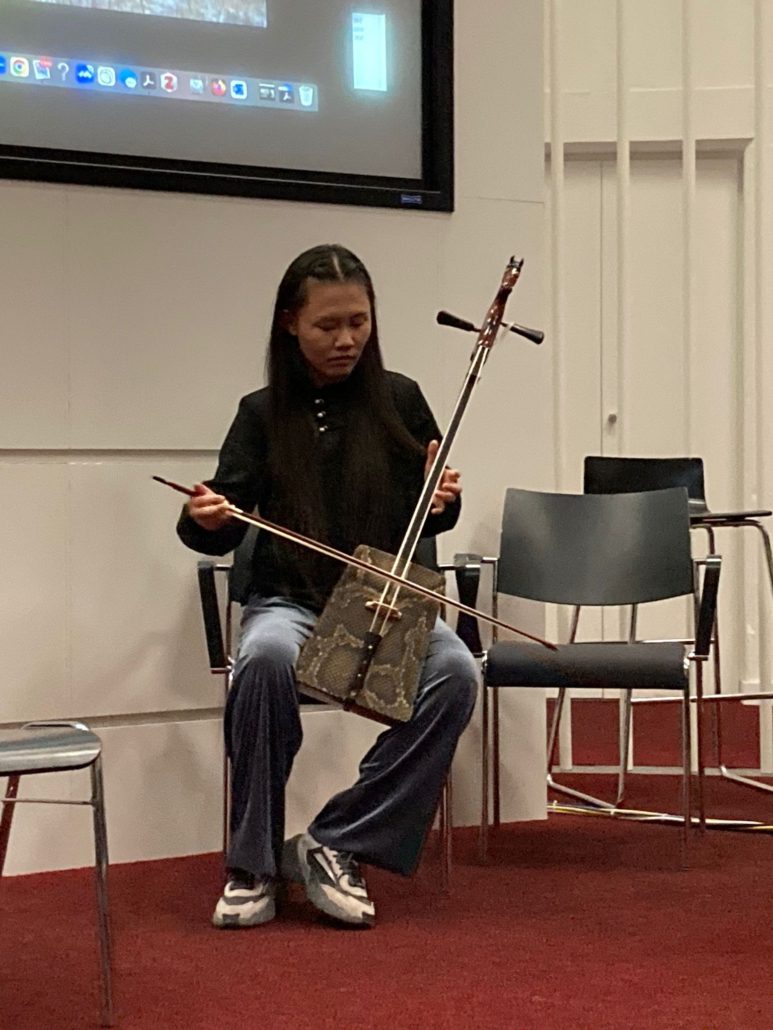
Sounds of the Mongolian Grasslands – An informal talk and recital with Mongolian horsehead fiddle player Nachin (China)

Moderator: Frank Kouwenhoven (CHIME, The Netherlands)

Nachin (那琴)

We met in person one of the upcoming talents of Morin Khuur (Mongolian horsehead fiddle): Nachin 那琴 (b.1994), a native from Ordos in Northwest China.

Nachin grew up in an entourage of farming life, amidst horses, cows, sheep, poultry, and camels, but from early childhood onwards she also had ample exposure to music.

‘While I was still in my mother’s belly I probably already heard the sounds of songs sung at local weddings.’

She began to learn the horsehead fiddle in her hometown region when she was eight years old.

She was lured by the instrument’s deep sounds and sturdy appearance. A Morin Khuur can play harmonies, overtones and solid notes simultaneously. Its large soundbox and horsetail bow-hairs contribute much to its unique tone, which can be loud and quite deep, often close in timbre to the human voice.

Nachin graduated in horsehead fiddle performance in 2020 from the Central University of Nationalities (Zhongyang Minzu Daxue, MUC) in Beijing, but she has always kept close ties with her native region. She has been carrying out extensive fieldwork among regional tribes in Mongolia and in Inner Mongolia since 2015. That included taking lessons from senior local masters like Burin and Badma

She acquired in-depth practical knowledge of a variety of different playing styles, some of which are now already becoming rare in living practice.

In this informal presentation (in English), she offered a brief introduction to some basic types of Mongolian horsehead fiddle (Morin Khuur), and presented three of the most prominent traditional genres, illustrated with video clips and live playing. Additionally, we had a brief talk with Nachin, to hear more about the realities of present-day life in rural Inner Mongolia.


Digital Dialogue: Comparisons and Transcultural Dialogues: Universal Love in Mohism and Christianity With Assoc. Prof. Yun WU (Shanghai) and Prof. Dr. Thorsten Moos (Heidelberg)

This Digital Dialogue was co-organized by the Heidelberg “Epochal Lifeworlds” Team and the Confucius Institute at the University of Heidelberg with its partner university, Shanghai Jiao Tong University. Wu Yun, Associate Professor of Philosophy at Jiao Tong University, and Thorsten Moos, Professor of Theology at the Heidelberg University, engaged in a dialogue on justifications of and engagements with ‘universal love’, with the potential of comparative ethics and universalist claims.

Different Justifications of Universal Love —A Comparison of the Mohist and Christian Ideas of Universal Love (Assoc. Prof. Yun WU)


Scholars often accentuate the affinity and even identity between the Mohist and Christian universal love. More than that, many of them even believe that both argue for an unconditional love. This paper argued however, that both propositions of universal love are not unconditional, as Mohism and Christianity propose “not harming others” and “the love of God” respectively as prerequisite of universal love. Upholding these two different prerequisites as the fundamental principle of justice entails two essentially different orientations of their universal love: humanism for Mohism and theism for Christianity.


About the speaker: Yun WU is Associate Professor in the Department of Philosophy, Shanghai Jiao Tong University. She received her PhD in 2012 from the Tsinghua University’s Department of Philosophy. Her dissertation topic was Locke and Rawls: Liberalism’s Contractual Justification of Toleration. For several years she tried to gain insight into toleration, equality, utility, and justice in political philosophy from comparative perspective. Most of her research publications are related to these subjects, such as “Is Mohism Really Li-promotionalism?” Asian Philosophy: An International Journal of the Philosophical Traditions of the East, 31:4, 430-440 (2021), “The Mohist Notion of Gongyi 公義”,Dao: A Journal of Comparative Philosophy, 19:269-287 (2020), and so on. Her academic interests include Mohism, Confucianism, and Chinese modern philosophy.

Doing Universality in Particular Religious Ethics – the Christian Example (Prof. Dr. Thorsten Moos)


Religions, especially Christianity, have often made universal validity claims concerning the true, the good and the right. Nonetheless, every specific religion is particular. In contemporary Western Christianity, there is a growing awareness of its own particularity. How does this affect its claim to universality? Starting with some comments on the paper by Yun Wu, I will elaborate the systematic problem of doing universality in particular religious ethics.


About the speaker: Thorsten Moos studied Theoretical Physics and Protestant Theology in Regensburg and Berlin as well as at Martin Luther University Halle-Wittenberg, where he also received his PhD. From 2010 to 2017 he was head of the research area “Religion, Law, Culture” at the Protestant Institute of Interdisciplinary Research (FEST) in Heidelberg. His habilitation at the Ruperto Carola was followed in 2017 by a call to a professorship at the Kirchliche Hochschule Wuppertal / Bethel. From 2019 on, he was head of the Institute for Diaconia Science and Diaconia Management there. Since 2021, Thorsten Moos has been Professor of Systematic Theology / Ethics at the Theological Faculty of Heidelberg University. His research interests include bioethics and medical ethics as well as theological anthropology and the concept of illness.

Konfuzius und die neue Weltordnung II: Das Lied von der Erde

Uraufführung — Ying WANG: Neues Werk , 2023

Gustav Mahler: Das Lied von der Erde, bearbeitet von Arnold Schönberg (1921); vervollständigt von Rainer Riehn (1983), 1907 / 1908

SCHOLA HEIDELBERG | ensemble aisthesis

Leitung: Walter Nußbaum und Ekkehard Windrich

Veranstalter: KlangForum Heidelberg

Fortsetzung von: Konfuzius und die neue Weltordnung I

Ying Wang trifft auf „Das Lied von der Erde“

Der sinfonische Liederzyklus “Das Lied von der Erde” (1909) steht als Ausnahmewerk in der Reihe der Sinfonien Gustav Mahlers, gleichzeitig aber in der Tradition des musikalischen Exotismus. (Der Bezug insbesondere auf Verdis “Aida” von 1871, ein Paradestück der Gattung, erweist sich inhaltlich wie im Spannungsverhältnis großer Besetzung und kammermusikalischer Verfeinerung als musikalisch plausibel.)
In einer Gegenwartsperspektive, die die Problematik kultureller Aneignung und Transkulturalität ins Spiel bringt, kann Mahlers Vertonung altchinesischer Lyrik in der Lesart Hans Bethges zum Anlass weiterführender Auseinandersetzung mit dem Exotischen und Fremden, aber auch seiner Konstruktion werden.

Das KlangForum Heidelberg bemüht sich, besonders in Zusammenarbeit mit dem CATS (Centre for Asian and Transcultural Studies an der Universität Heidelberg) um kritische Infragestellung des eurozentrischen Begriffs von Musikgeschichte und Ästhetik. Auch in diesem Sinne ermöglicht das Auftragswerk an die chinesische Komponistin Ying Wang (*Shanghai 1976), eine Reihe von Intermezzi zwischen den sechs Sätzen von Mahler, immer wieder den Perspektivwechsel: Die vom ensemble aisthesis zusammen mit zwei hervorragenden SolistInnen der SCHOLA HEIDELBERG gespielte Adaption von Mahlers Zyklus im Geist der Schoenberg-Schule und des Wiener Vereins für musikalische Privataufführungen (B: Arnold Schönberg, Rainer Riehn), verbindet sich mit Wangs Uraufführung zu einem neuen, transkulturell gedachten “Lied von der Erde”.

Eine Kooperation mit:


Gefördert durch: