Memory has become one of the central categories through which the humanities interrogate the past, the self, and the conditions of historical knowledge. Far from being a mere repository of bygone events, memory unfolds at the intersection of experience, narration, embodiment, and cultural transmission. This conference invites graduate students from across the humanities to explore memory as a dynamic and contested field—one in which individual recollection, communicative exchange, and culturally sedimented forms of remembrance are in constant dialogue.
Drawing on theories of cultural memory, this conference encourages reflections on how societies stabilize, ritualize, and transform images of the past through texts, images, practices, and institutions, while also attending to communicative memory as it circulates in everyday interactions and lived social relations. Equally central is the notion of collective memory, which foregrounds the ways in which remembering is never purely private but shaped by social frameworks, power relations, and shared imaginaries. What are the functions of different dimensions of memory, how should its media (such as writing, images, or monuments) be evaluated, and what forms of dealing with stored knowledge exist that attach growing importance not only to history, politics, and science, but also to art? In an increasingly interconnected world, different dimensions of memory further cannot always be adequately understood without addressing questions of transculturality: the movement of memories across borders, languages, and historical contexts, as well as the frictions and creative reconfigurations that arise from such encounters.
This conference particularly welcomes interdisciplinary and comparative approaches that open new perspectives on memory beyond national or disciplinary boundaries.
Conference program and schedule can be found here.

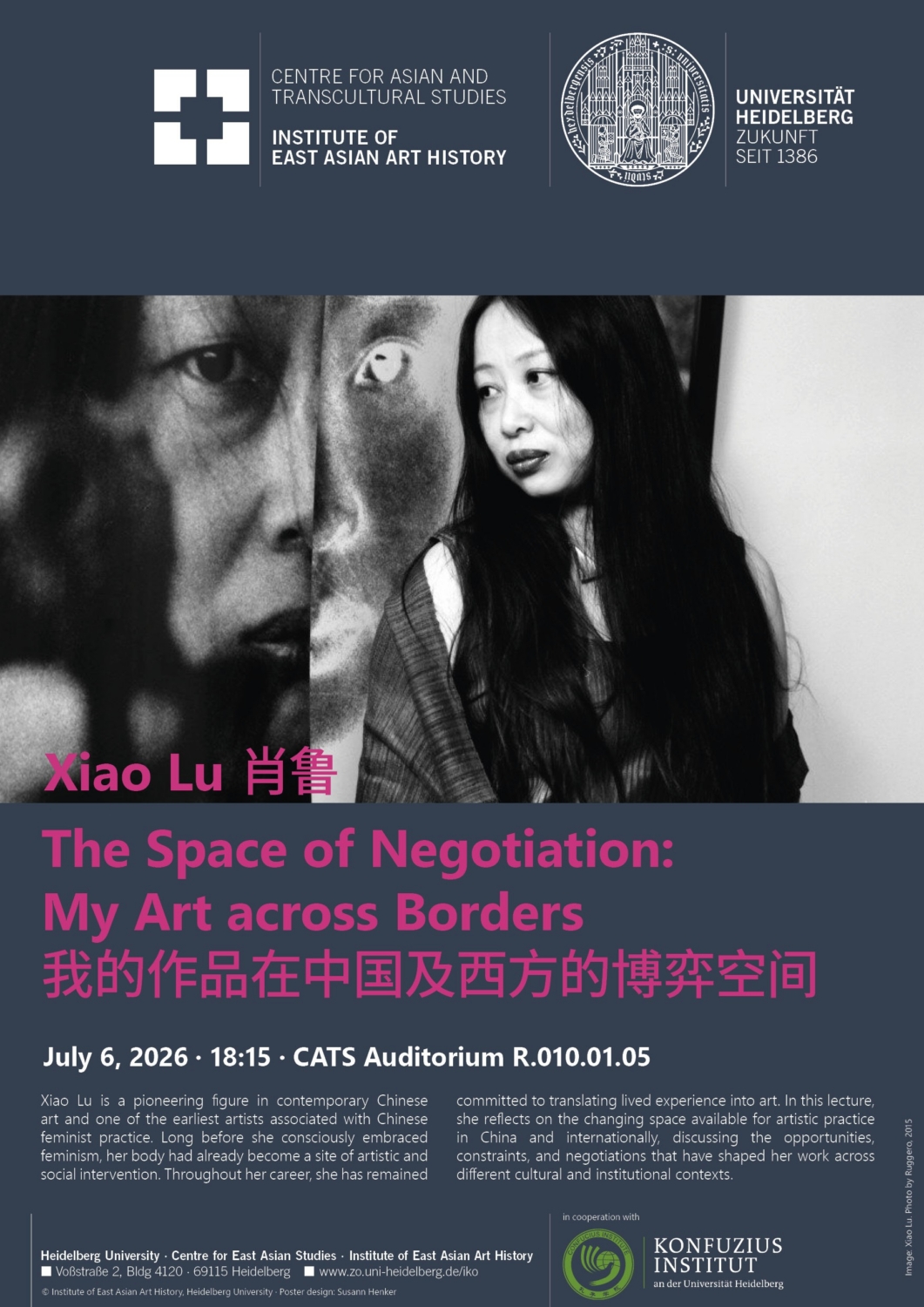 Xiao Lu is a pioneering figure in contemporary Chinese art and one of the earliest artists associated with Chinese feminist practice. Long before she consciously embraced feminism, her body had already become a site of artistic and social intervention. Throughout her career, she has remained committed to translating lived experience into art. In this lecture, she reflects on the changing space available for artistic practice in China and internationally, discussing the opportunities, constraints, and negotiations that have shaped her work across different cultural and institutional contexts.