
Ostasien Aktuell: Rethinking the China Model: Land, Growth, and Pathway to Transformation
Abstract:
The rapid rise of China’s economy over the past forty years has been one of the most striking phenomena in the contemporary world, while the enormous challenges it now faces have renewed debates about the concept of the “China model.” Drawing on decades of empirical research, Professor Tao Ran offers a systematic reinterpretation of this term. He critiques popular hypotheses such as the “local officials’ promotion race” and instead places land institutions at the core of his analysis. He identifies three administrative monopolies (banks, urban land, and state-owned enterprises), two tiers of competitive pressure (international and domestic), and one domain of market competition (private manufacturing). While this model has fueled remarkable growth, it has also led to significant structural problems, including real estate price bubbles, mounting local government debt, and widening social inequality. How can we deepen our understanding of China’s development model, how does it differ from that of other East Asian economies, and what transformations are needed to make it more sustainable and equitable? We are honored to welcome Professor Tao Ran to share his insights.
Zur Person:
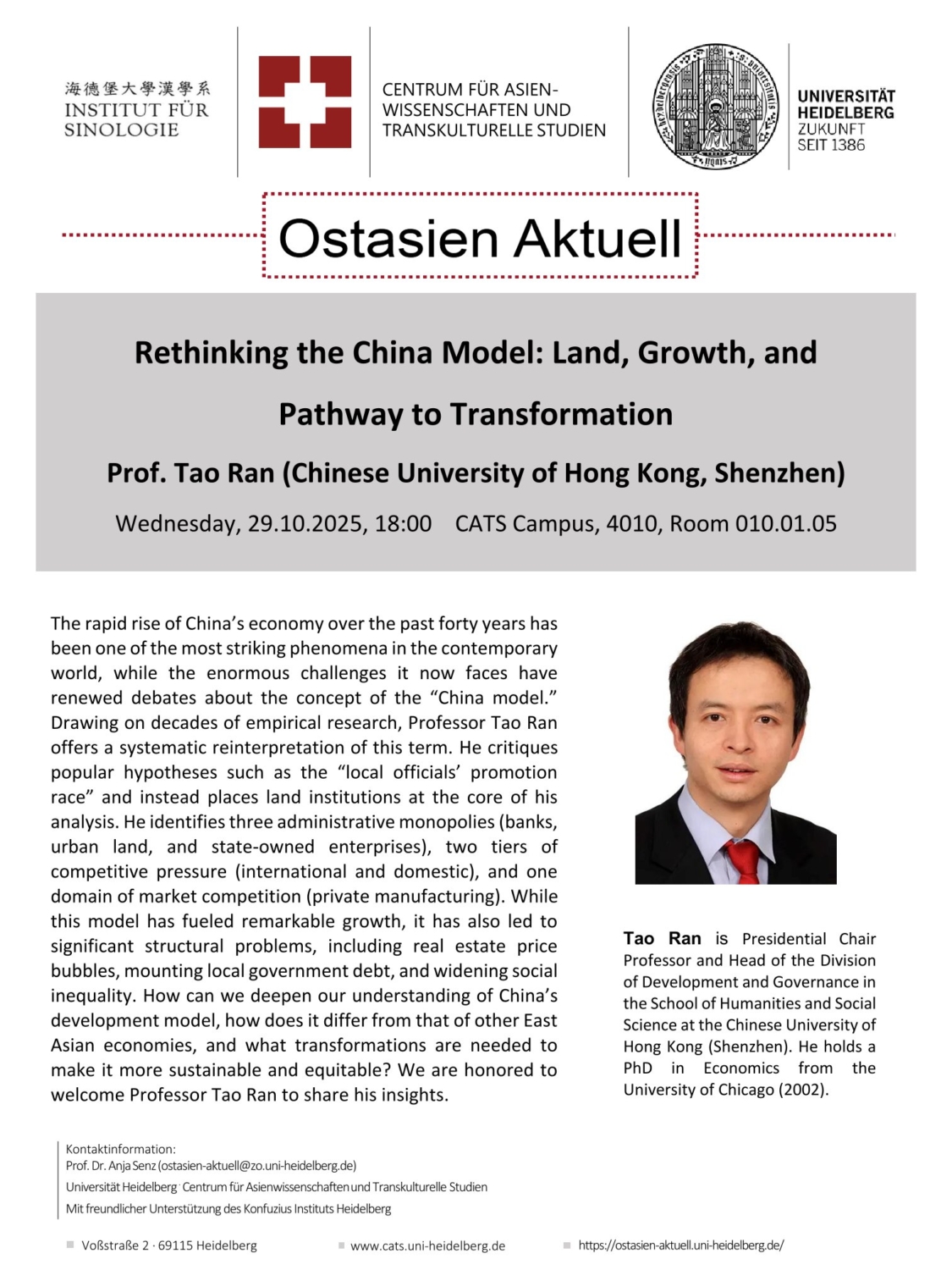
Tao Ran is Presidential Chair Professor and Head of the Division of Development and Governance in the School of Humanities and Social Science at the Chinese University of Hong Kong (Shenzhen). He holds a PhD in Economics from the University of Chicago (2002).

